- contact@techverda.com
- Innovation One, DIFC, Dubai

Blog Detail
Open Source AI Challenges Giants: Z.ai's GLM-Image Excels at Text, But How Does It Stack Up?
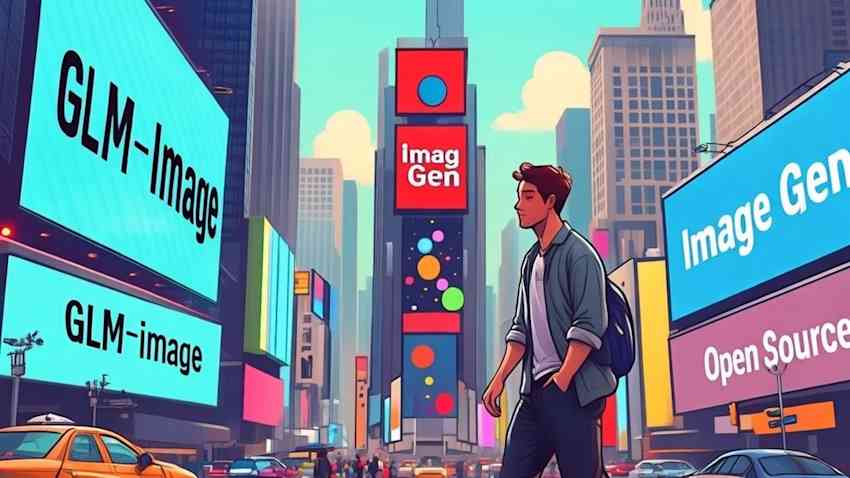
Open Source AI Challenges Giants: Z.ai's GLM-Image Excels at Text, But How Does It Stack Up?
The AI landscape in 2026 is heating up, with major players like Anthropic and Google releasing impressive models. Google's Gemini 3 family, particularly the Nano Banana Pro (Gemini 3 Pro Image), has been making waves with its ability to generate complex, text-heavy infographics. But what if you're looking for an open-source alternative that offers power, flexibility, and cost-effectiveness? Enter Z.ai's GLM-Image, a new 16-billion parameter model that's shaking up the image generation scene.
A New Contender in Text-Heavy Image Generation
While proprietary models like Nano Banana Pro have set a high bar, the open-source community is rapidly catching up. GLM-Image, developed by Chinese startup Z.ai, is a significant step forward. Instead of relying solely on the common "pure diffusion" architecture, GLM-Image employs a novel hybrid approach, combining auto-regressive (AR) and diffusion techniques. This architectural shift allows it to excel in areas where other models often struggle: creating visuals packed with accurate, well-placed text, such as infographics, slides, and technical diagrams.
Precision Over Aesthetics?
The headline feature of GLM-Image is its precision. In the CVTG-2k benchmark, which specifically tests the ability to render text accurately across an image, GLM-Image achieved an impressive Word Accuracy average of 0.9116. This dramatically outperforms Google's Nano Banana Pro, which scored 0.7788 on the same benchmark. For enterprise use cases where every word counts—think marketing collateral or training materials—this level of accuracy is not just a bonus, it's a necessity.
However, the article notes that in practical, hands-on testing, GLM-Image's instruction following and text rendering might not always match the benchmark results. While Nano Banana Pro benefits from integration with Google Search, allowing it to pull in external information, GLM-Image relies more on the specificity of the prompt. This highlights a common trade-off: cutting-edge performance in a specialized area versus broader, more user-friendly capabilities.
Furthermore, when it comes to pure aesthetics, Nano Banana Pro still holds a slight edge. Benchmarks show Google's model producing slightly more visually appealing images, suggesting that while GLM-Image is a powerhouse for information density, it may not always match the artistic polish of its proprietary counterpart.
The Secret Sauce: A Hybrid Architecture
GLM-Image's success in handling dense text lies in its unique architecture, which Z.ai describes as treating image generation as a reasoning problem first, and a painting problem second. This is achieved through a two-part system:
- The Auto-Regressive Generator (The "Architect"): Powered by Z.ai's GLM-4-9B language model, this module processes the prompt logically. It doesn't create pixels directly but outputs "visual tokens." These tokens serve as a blueprint, locking down the image's layout, text placement, and object relationships before any visual rendering begins. This leverages the reasoning capabilities of large language models to understand complex instructions.
- The Diffusion Decoder (The "Painter"): This module, based on the CogView4 architecture, takes the blueprint from the AR generator and fills in the high-frequency details—textures, lighting, and style—using a diffusion transformer.
By separating the "what" (layout and logic) from the "how" (visual execution), GLM-Image effectively solves the challenge of embedding dense, accurate information within an image.
Training for Precision
The training process for GLM-Image is also noteworthy. Z.ai focused on teaching the model structure before detail. This involved:
- Freezing the text embedding layer of the original GLM-4 model and training a new "vision word embedding" layer, enabling the LLM to "speak" in images.
- Employing a progressive resolution strategy, starting with low-resolution images and gradually increasing the resolution. Crucially, they introduced a progressive generation strategy that prioritizes generating "layout tokens" first, ensuring the composition is sound before high-resolution details are added.
Licensing: An Enterprise Win
For businesses, the licensing of GLM-Image is a major draw. While there's a slight ambiguity between the MIT and Apache 2.0 licenses referenced in different parts of the release, both are highly permissive for commercial use. This means companies can:
- Freely use, modify, and distribute GLM-Image.
- Integrate it into proprietary products without being forced to open-source their own code (unlike copyleft licenses).
- Potentially benefit from Apache 2.0's explicit patent grant clause, reducing litigation risks.
This permissive licensing allows for self-hosting, fine-tuning on sensitive data, and building commercial applications without vendor lock-in, a stark contrast to the API-based, cost-per-use models of proprietary solutions.
The Catch: Compute Power and Speed
The advanced capabilities of GLM-Image come with a significant requirement: compute power. Its dual-model architecture is resource-intensive, meaning image generation can take considerably longer (around 252 seconds on an H100 GPU for a single 2048x2048 image) compared to more optimized, smaller diffusion models. While this latency might be acceptable for high-value assets, it's a factor businesses need to consider.
For those hesitant about investing in heavy hardware, Z.ai does offer a managed API at a competitive rate, providing a stepping stone to explore GLM-Image's potential.
The Future is Open and Precise
GLM-Image represents a pivotal moment where open-source AI isn't just keeping pace but is actively setting the standard in specialized, high-value domains like knowledge-dense image generation. For enterprises struggling with the reliability of complex visual content, the message is clear: powerful, customizable, and cost-effective solutions are increasingly available outside the closed ecosystems of major tech companies. The era of self-hosted, precisely controlled AI-generated visuals has arrived.
Can You find Now