- [email protected]
- Innovation One, DIFC, Dubai

Blog
AI Teams Learn to Talk: AgentRadio Revolutionizes Codebase Analysis
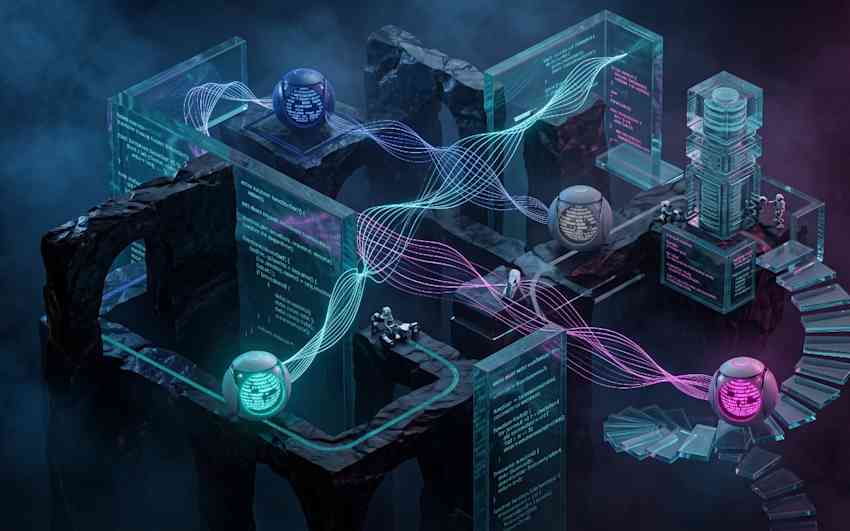
AI Teams Learn to Talk: AgentRadio Revolutionizes Codebase Analysis
Ever felt overwhelmed by a massive project, wishing you had a whole team to tackle it? That's the challenge AI agents face when diving into complex enterprise codebases. While splitting the work sounds like a no-brainer, most multi-agent systems stumble because they can't coordinate effectively in real-time. Enter AgentRadio, a groundbreaking development from Coral AI Labs and university researchers that's changing the game.
AgentRadio introduces an asynchronous message-passing layer, allowing AI agents to communicate and share insights *while* they're working, not just after. This means they can course-correct on the fly, avoiding dead ends and dramatically improving efficiency. In tests on enterprise coding tasks, a team of four AI agents using AgentRadio nearly doubled the accuracy compared to independent agents, even outperforming single agents running on more advanced models. This is a powerful demonstration that smart coordination can trump sheer model power or compute scale.
The Perilous Path of Codebase Understanding
Understanding vast code repositories is a monumental task. It requires AI to build, execute, trace, and synthesize information over extended periods – a true test of long-horizon capabilities. Traditional single-agent systems often falter due to the "coverage problem". As they navigate a codebase, their initial plans become rigid, and late-breaking discoveries struggle to propagate. This can lead to incomplete or incorrect conclusions because the agent can't effectively juggle all the evolving information.
Benchmarks like SWE-Atlas QnA highlight this challenge. These tests involve complex, multi-step questions over live production code, requiring agents to not just read code but also run software and execute commands. A single Claude Code agent on Opus 4.6 could only solve about 32.3% of these tasks, with even the latest Opus 4.8 reaching just 57.2%. While distributing the work among multiple agents is a logical next step, codebase analysis is rarely cleanly divisible. Subtasks are deeply interdependent; a finding by one agent can completely alter the path for another.
When Agents Can't Talk, Progress Stalls
The core issue with many current multi-agent systems is their communication structure. They often fall into one of three traps:
- Parallel but Isolated: Agents work simultaneously but never share information.
- Parallel but Round-Synchronized: Agents can communicate, but only at strict, predetermined intervals. This forces them to wait, potentially missing crucial real-time insights. Imagine one agent finding a bug, but having to wait for the next "communication round" to tell another agent investigating a related component.
- Asynchrony in Adjacent Forms: These offer limited asynchronous features, like basic task dispatching, but lack the peer-to-peer, real-time chat essential for complex collaboration.
The fundamental bottleneck, as researchers put it, is that "an agent that is working cannot also be listening."
Enter AgentRadio: Seamless, Asynchronous Collaboration
AgentRadio tackles this head-on by enabling agents to communicate without halting their primary tasks. It uses three key primitives:
- create_thread: Initiates a conversation between agents.
- send_message: Sends a message without blocking the sender.
- wait_for_mention: Allows an agent to continue working but pause when a relevant message arrives, instantly providing context.
This creates a state of "passive awareness," where agents can keep working while staying updated on team progress. AgentRadio is designed to be lightweight and integrate with existing agent harnesses, primarily through a central message server and simple shell scripts.
AgentRadio in Action: Real-World Impact
The results are striking. On the SWE-Atlas QnA benchmark, the AgentRadio-powered team achieved a 62.1% success rate, significantly outperforming both single agents and less coordinated multi-agent setups. Even more impressively, it surpassed the 57.2% success rate of a single agent running on a more advanced model.
A compelling real-world example involved a MinIO system task. Without AgentRadio, two agents independently discovered the need for server logs but couldn't share this mid-task. The team ultimately reached the wrong conclusion. With AgentRadio, one agent instantly broadcasted the log requirement, and the others immediately incorporated it, turning a failing score into a perfect one.
The Cost and Complexity of Coordination
While AgentRadio offers incredible benefits, it's not without costs. The token usage and API spend increase due to the multi-agent setup. However, the researchers found that the performance gains significantly outweighed the increased cost compared to simply scaling up a single agent. The key takeaway is that effective architecture trumps brute-force scaling.
The researchers also emphasize that multi-agent systems aren't a one-size-fits-all solution. They are most effective for tasks with "responsibility breakpoints" – situations where involving another specialist or independent verification is natural. This includes complex repository-wide analysis, incident investigation, and cross-service debugging.
Beyond Research: Coral Code and the Future
The principles behind AgentRadio are evolving into a commercial product called Coral Code. This aims to bring dynamic, context-aware multi-agent collaboration to engineers without requiring a rigid, upfront team structure.
The future of autonomous software engineering hinges on better "attention governance and verification". While AgentRadio allows agents to communicate, deciding *what* to communicate, *who* to communicate with, and *when* is still an open challenge. Future systems will need adaptive responsibility assignment, evidence-aware routing, and robust provenance tracking to ensure accountability and prevent communication overload. As AI agents tackle increasingly complex, long-running tasks, their ability to coordinate effectively will be paramount.
Can You find Now