- [email protected]
- Innovation One, DIFC, Dubai

Blog
Stanford's "Virtual Biotech" Revolutionizes Drug Discovery with 37,000 AI Agents
Stanford's "Virtual Biotech" Revolutionizes Drug Discovery with 37,000 AI Agents
Forget the idea of a single, all-powerful AI. The future of artificial intelligence, at least in complex fields like biotechnology, might be a massive, collaborative workforce. That's the groundbreaking vision being realized at Stanford University, where researchers have built a "Virtual Biotech" company powered by an astonishing 37,000 specialized AI agents. This isn't just a theoretical exercise; one of its AI-designed drug candidates has been independently confirmed by pharmaceutical giant Merck, a significant validation of this multi-agent approach.
From Virtual Lab to Virtual Biotech: A Scaling Success Story
The journey began with a modest "Virtual Lab," a team of five to eight AI agents designed to mimic James Zou's physical Stanford lab. With an AI professor acting as the principal investigator and AI students with specific expertise, this miniature virtual environment proved capable of designing new nanobody proteins for COVID variants. The results were compelling: these AI-designed proteins performed better than human-designed ones.
The real leap forward came with the expansion into the "Virtual Biotech." This massively scaled system, overseen by a Chief Scientific Officer (CSO) agent, mirrors the divisions of a human biotech company: target discovery, molecule design, and clinical trials. Within these divisions, thousands of agents specialize further, each focusing on specific data types like genetics, genomics, or single-cell data.
The Power of the Collective: Why 37,000 Agents Beat One
A key question arises: why use so many agents when AI models are becoming increasingly powerful? Zou's research suggests a critical advantage in collaboration. In head-to-head tests, the multi-agent ecosystem outperformed a single, highly capable AI model on the same scientific challenge. The interactions, disagreements, and debates among the specialized agents led to more creative, robust, and resilient solutions. This "friction" inherent in a collaborative system prevents compounding errors and fosters deeper reasoning.
Overcoming the Orchestration Bottleneck
Scaling to such vast numbers of agents presents a significant challenge: orchestration. How do you ensure these agents can effectively share knowledge, access data, and work towards a common goal? Traditional methods of connecting databases to AI are insufficient. Zou's team developed a novel platform called Paperclip. Instead of forcing agents to interact with complex, human-designed APIs, Paperclip digitizes unstructured data and creates an AI-native virtual file system. This allows agents to access and synthesize information from millions of documents and disparate databases using familiar file system operations, drastically improving accuracy and efficiency.
Real-World Impact: A Merck-Validated Breakthrough
The tangible results of the Virtual Biotech are staggering. 37,000 "clinical trial agents" were deployed to analyze fragmented trial data, identifying single-cell features that predict trial success. This led to the autonomous design of an antibody-drug conjugate (ADC) targeting CD276 for lung cancer. The truly remarkable part? Pharmaceutical company Merck independently developed and validated the exact same therapeutic design, which subsequently received FDA breakthrough designation. This independent confirmation underscores the power and potential of AI-driven collaborative research.
Shifting Gears: From Workflows to Environments
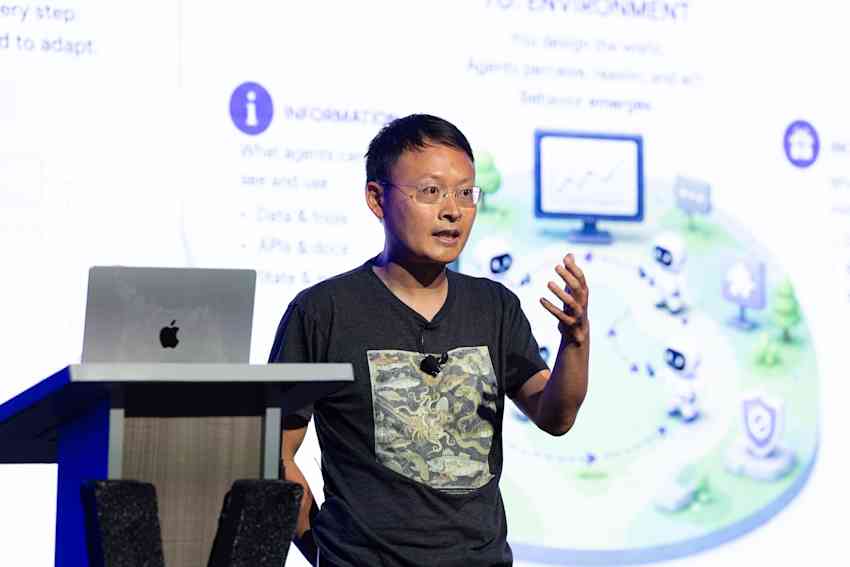
The success of these large-scale multi-agent systems signals a paradigm shift in how we manage AI. Instead of designing rigid workflows that dictate every step, the focus is moving towards creating dynamic environments. These environments provide the necessary infrastructure, guardrails, and incentives for agents to collaborate on complex, open-ended problems. Optimization at scale, therefore, means refining the collaborative environment itself, rather than continuously fine-tuning individual models.
The implications of Stanford's Virtual Biotech are immense. It demonstrates a powerful new model for scientific discovery and product development, promising to accelerate innovation across various industries. The era of tens of thousands of AI agents working in concert has officially begun.
Can You find Now